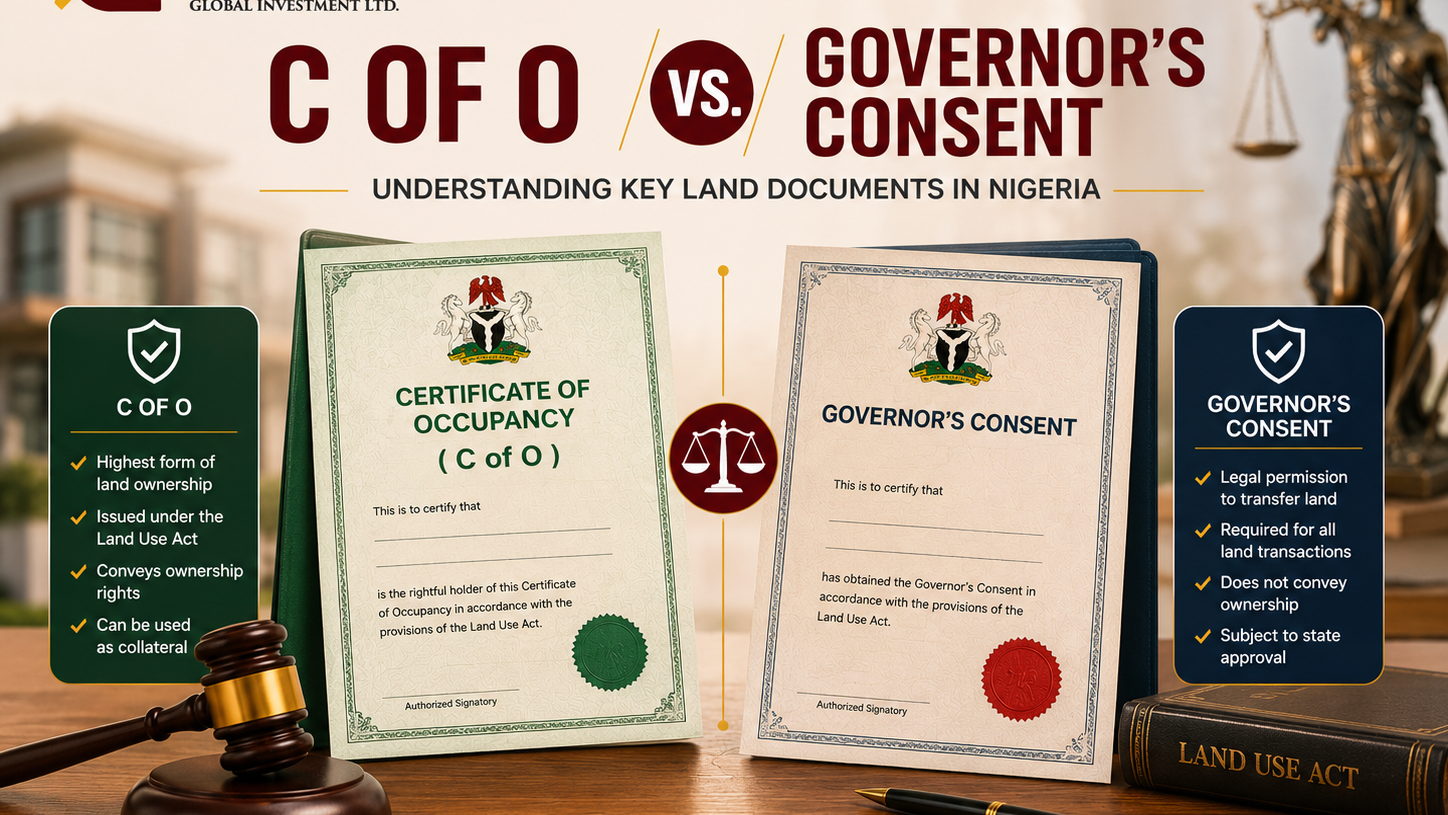
C of O vs. Governor's Consent: Understanding Key Land Documents in Nigeria
Introduction: Securing Your Investment with Proper Documentation
Investing in Nigerian real estate, whether for residential, commercial, or land banking purposes, offers immense potential. However, the path to secure ownership is paved with critical legal documentation. Two terms frequently encountered and often confused are the Certificate of Occupancy (C of O) and Governor's Consent. Understanding the distinct roles of these documents is not just a matter of legal formality; it is fundamental to protecting your investment and ensuring undisputed ownership.
At Garnet Bricks, we believe that informed clients make the best decisions. This guide will clarify the difference between a C of O and Governor's Consent, explaining why both are indispensable for anyone looking to acquire property or land in Nigeria.
Understanding the Certificate of Occupancy (C of O)
The Certificate of Occupancy, commonly known as the C of O, is a primary land document issued by the state government. It signifies a statutory right of occupancy granted to an individual, group, or corporate entity over a specific parcel of land for a fixed term, typically 99 years.
What the C of O Represents:
- Initial Grant of Right: It is the first official document that vests the right to occupy and use a piece of land in the hands of the allottee directly from the state government.
- Proof of Ownership (Primary): The C of O serves as the government's acknowledgment of your legal interest in the land, establishing your primary title against other claims, provided it is valid and properly issued.
- Term-Limited Right: While often referred to as 'ownership,' it's technically a leasehold interest for a specific duration, after which it can typically be renewed.
Without a valid C of O, your claim to a piece of land, especially one directly allocated by the government, is significantly weakened, making it difficult to transact or defend against disputes.
 Inline image 1
What is Governor's Consent?
Governor's Consent is another crucial document, but it comes into play under different circumstances. It is the formal approval granted by the State Governor for the transfer of an existing statutory right of occupancy (i.e., land that already has a C of O) from one party to another.
When Governor's Consent is Required:
- Secondary Transactions: When a property owner (who holds a C of O) decides to sell, lease, mortgage, or transfer their interest in the land to another person or entity, Governor's Consent becomes mandatory.
- Legalizing Transfers: The Land Use Act of 1978 mandates that all transactions involving the transfer of a statutory right of occupancy must receive the Governor's Consent to be legally valid and enforceable. Without it, the transaction is deemed incomplete and void in the eyes of the law.
- Government Acknowledgment: It ensures that the government is aware of and approves the change in ownership/occupancy rights for a particular parcel of land.
Think of it this way: if the C of O is your initial permit to 'drive' the land, the Governor's Consent is the official approval needed to 'transfer that permit' to another driver.
Key Differences: C of O vs. Governor's Consent
While both documents are essential for establishing and securing land rights in Nigeria, their roles are distinct:
Nature of the Grant
- C of O: Represents the initial grant of a statutory right of occupancy from the state government to the first allottee. It creates the primary title.
- Governor's Consent: Represents the approval for the transfer of an existing statutory right of occupancy from one private party to another. It validates secondary transactions.
Purpose and Function
- C of O: Its purpose is to establish and confirm the primary legal interest of the holder in a specific parcel of land directly from the government.
- Governor's Consent: Its purpose is to legitimize and acknowledge a change of ownership for land already covered by a C of O, ensuring the government is aware of the new holder of the right.
Timing in Property Transactions
- C of O: Is typically processed at the initial stage of acquiring land directly from the government or regularizing untitled land.
- Governor's Consent: Is required subsequent to the issuance of a C of O, whenever the land is transferred from one individual or entity to another.
Why Both Are Crucial for Property Investors
For any property buyer, land investor, or diaspora client, understanding and ensuring the validity of both the C of O and Governor's Consent is paramount:
- Legal Certainty: These documents provide the strongest legal backing for your property rights, minimizing the risk of disputes and ensuring your investment is secure.
- Facilitating Future Transactions: A property with a valid C of O and, if applicable, a properly obtained Governor's Consent, is easier to sell, lease, or use as collateral.
- Avoiding Government Acquisition: Properly documented land ensures your property is recognized by the state and less susceptible to unforeseen government acquisition or revocation.
- Peace of Mind: Knowing your property is legally sound offers invaluable peace of mind, allowing you to focus on the returns of your investment.
The Role of Due Diligence in Nigerian Property Transactions
Given the complexities, thorough due diligence is non-negotiable. Before committing to any property purchase, it is essential to:
- Verify the authenticity and validity of the C of O.
- Confirm that all necessary Governor's Consent processes have been completed for previous transfers.
- Engage experienced legal professionals and reputable real estate advisors.
Frequently Asked Questions
- Which document is 'stronger' – C of O or Governor's Consent?
Neither is inherently 'stronger' than the other; they serve different purposes at different stages of land ownership. The C of O establishes the initial right of occupancy from the government. Governor's Consent legally validates subsequent transfers of that right. Both are crucial for a complete and secure title, depending on whether you are the original allottee or a subsequent buyer. - Can I buy land with only a C of O and no Governor's Consent?
If you are buying land from someone who is not the original allottee (i.e., they themselves bought it from another individual or entity), then you will need to process Governor's Consent to legally transfer the existing C of O into your name. Buying without Governor's Consent in such a scenario means the government does not officially recognize you as the new owner, leaving your title vulnerable. - How long does it take to process Governor's Consent?
The processing time for Governor's Consent varies significantly by state in Nigeria due to administrative processes. It can range from a few months to over a year. Engaging experienced professionals like Garnet Bricks and legal experts can help streamline the process.
Conclusion
The journey to secure land ownership in Nigeria is intricate, with the Certificate of Occupancy and Governor's Consent standing as two pillars of legal validity. While the C of O grants the initial right of occupancy, Governor's Consent ensures the legal transfer of that right in subsequent transactions. For every Nigerian property buyer, land investor, and diaspora client, understanding these distinctions and ensuring proper documentation is not just advisable—it's imperative for a secure and profitable investment. Always prioritize thorough due diligence and seek professional guidance to navigate these legal landscapes successfully.
Call to Action
Ready to make a secure real estate investment in Nigeria? Let Garnet Bricks guide you through every step, ensuring your property documents are impeccable. Contact us today for expert advice on C of O, Governor's Consent, and all your property needs!



Comments
Comments are reviewed before they appear publicly. Share your thoughts using your name and email address.